Friday, 10 October 2014

The imaginary and Eternal Prisons of Piranesi

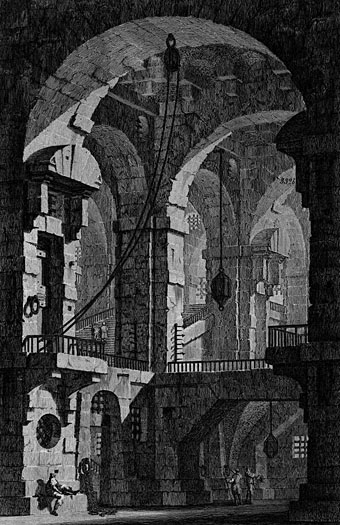
I found an hour long documentary on Piranesi and his imaginary prisons series, in which Yo-Yo Ma investigates the relationship between music and visual art. In this film, the talented cellist plays the music of Bach in a virtual prison based on the Carceri, the imaginary prisons found in the etchings of Giovanni Battista Piranesi. Along the way, audiences hear from architect Moshe Safdie and others while learning of Piranesi's only built church project, the Santa Maria del Priorato.

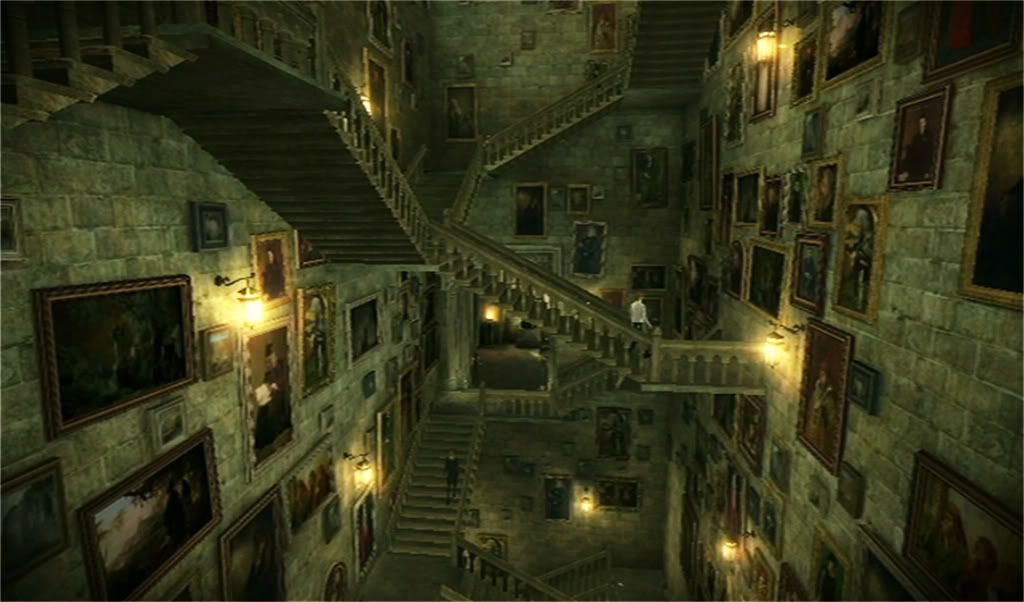
The exhibition, Piranesi, Rome, and the Arts of Design, includes a complete set of the prison etchings as well as an innovative 3-D video projection based on them. Before the film, Dr. John Marciari, Curator of European Art and Head of Provenance Research, will give a lecture about the haunting, nightmarish world of Piranesi's prisons, architectural fantasies that demonstrate the dark side of Piranesi's imagination. Prefiguring the dark imagining of the Romantic era, the Carceri are thought to have been the later model for everything from M.C. Escher's designs, to the city of Fritz Lang's Metropolis, to the moving staircases of Harry Potter's Hogwarts.


Below is the video of Yo-Yo Ma's investigation into the relationship between music and visual art using the Prisons series as inspiration for the set. I really like the way it looks and I think the whole thing creates an atmosphere the represents Piranesi's Prisons really well. 

Who is commissioning the project?

During my tutorial it was suggested that I find out who my project is for, who has commissioned my piece. Doing this I'll be able to point my project in the appropriate direction, deciding whether I'll need a voice over, a music track or if it'll be educational ect..
I was given a few ideas to look at making my project into an informative interactive app, or having an instillation piece in an Art gallery/Museum, or as an animated short for the Art/History Channel. I thought I would give a bit of research into each before I decided what I was going to do.

Interactive App

For the Interactive app the basic idea would be to separate the environment into different areas that can be chosen by the viewer and explored. Information about Piranesi and different aspects of his life can be given depending on which area has been chosen.
For this idea I would fake the interactive aspect and only make certain areas and have certain information that is given, but it would appear to the viewer that they have the choice to chose many other options if they decided to.
A recent graduate Bharathi Anthonysamy for his Major project created Num Num, an interactive game where you need to feed the character Num Num.


Below is a video tutorial on a book that you can download an app for and over certain pages if you hover your phone, or tablet over it then it plays a video. If you fast forward the video to 7.30 then it demonstrates the use of the phone app with the book. 


Art Galleries/ Museums

I think there is quite a big distinction between if I chose to do this project for an Art Gallery or an Art Museum, because with an Art Gallery the project can become quite abstract and very "Arty" for lack of a better word. Where as with an Art Museum the project can be more informative or representative, something that would accompany an exhibition of Piranesi's work. A lot like the 12 minute animation made by Gregoire Dupond, that I posted in a previous post. Maybe something that has a voice over of someone talking about Piranesi and his work. I would quite like to take the project in this direction but I am a little unsure as to exactly how I would do it, and if I did have a voice over what the content would be.
With an Art Gallery I could take it in a really abstract way make it all representative and about the mind. I would have the animation an experience into the labyrinths of the subconscious and explore the idea of being trapped. A lot like how Thomas De Quincy describes Piranesi's prisons in his book Confessions of an English Opium Eater. This is also an idea I am quite attracted to because I think it would be quite interesting creating the environment in this way.

Art/History Channel

If I did it this way then It would be similar to the way I would do it for an Art Museum except I would make it more educational and a voice over would be necessary. It would information about Piranesi, specifically about him around the time when he created the Prisons series. I'm not sure if I want to go this root I prefer the Art Galleries/ Museums root.

Monday, 6 October 2014

Piranesi's Carceri series made by Gregoire Dupond

I came across this 12 minute animation by Gregoire Dupond, that was made for the exhibition Le Arti di Piranesi: architetto, incisore, antiquario, vedutista, designer (The Art of Piranesi: architect, engraver, antiquarian, vedutista, designer). The exhibition opened on 28th August 2010 to coincide with the Venice Biennale of Architecture and ran until 9th January 2011. The exhibition was showcased in the Sale del Convitto on the island of San Giorgio Maggiore, and after the inauguration it travelled to different venues.
This animation is similar in a way to what I want to achieve with my animation but there are still a number of differences.  

Piranesi's Versions of "Le Carceri"

Through my research I have discover that Piranesi had two versions of Le Carceri the first state prints were published in 1750, were called "Invenzioni Capric di Carceri" by Piranesi and consisted of 14 etchings, untitled and unnumbered, with a sketch-like look. For the second publishing in 1761, all the etchings were reworked and numbered I–XVI. Numbers II and V were new etchings to the series. Numbers I through IX were all done in portrait format, while X to XVI were landscape.

First edition of "Invenzioni Capric di Carceri" 14 etchings in 1750
Second edition of "Invenzioni Capric di Carceri" renamed as "Carceri d'invenzione" 16 etchings 1761

The second edition of the Prisons were a bit darker, they had more substance to them. The second edition of the prints are what I'm going to work with for my project. 

People influenced by Piranesi

Following on from the research I did before I looked into some of the writers, artists ect that I learnt had taken influence from Piranesi's work.

Thomas De Quincy "Confessions of an English Opium Eater"

Thomas De Quincy does not say much about Piranesi in his book Confessions of an English Opium Eater, he is only mentioned in one paragraph.

"Many years ago, when I was looking over Piranesi’s, Antiquities of Rome, Mr. Coleridge, who was standing by, described to me a set of plates by that artist, called his Dreams, and which record the scenery of his own visions during the delirium of a fever. Some of them (I describe only from memory of Mr. Coleridge’s account) represented vast Gothic halls, on the floor of which stood all sorts of engines and machinery, wheels, cables, pulleys, levers, catapults, &c. &c., expressive of enormous power put forth and resistance overcome. Creeping along the sides of the walls you perceived a staircase; and upon it, groping his way upwards, was Piranesi himself: follow the stairs a little further and you perceive it come to a sudden and abrupt termination without any balustrade, and allowing no step onwards to him who had reached the extremity except into the depths below. Whatever is to become of poor Piranesi, you suppose at least that his labours must in some way terminate here. But raise your eyes, and behold a second flight of stairs still higher, on which again Piranesi is perceived, but this time standing on the very brink of the abyss. Again elevate your eye, and a still more aĆ«rial flight of stairs is beheld, and again is poor Piranesi busy on his aspiring labours; and so on, until the unfinished stairs and Piranesi both are lost in the upper gloom of the hall. With the same power of endless growth and self-reproduction did my architecture proceed in dreams. In the early stage of my malady the splendours of my dreams were indeed chiefly architectural; and I beheld such pomp of cities and palaces as was never yet beheld by the waking eye unless in the clouds."

A lot can be taken from this passage as De Quincy never actually saw the plates himself they were described to him and he could instantly visualize the unseen works and recognize in them the dark recesses of his own opium dreams. There is also a significant feature which has intruded into the account and can not be verified by an inspection of the actual plates. De Quincy describes multiple replications of Piranesi within each plate as a wandering figure. The artist imprisoned in his own nightmare dungeons.
I think De Quincy's dreams he had while visualising the plates are quite accurate, from all that I have read about Piransi it seems like he was quite an unhappy person having failed at achieving his dream of becoming an architect and sold his etchings he did as souvenirs. I think that he felt trapped and his etchings of the prisons is a representation of his time in Rome and a projection of how he felt. The elaborate design of an enormous prison that seems to be a city within itself, and has no escape.

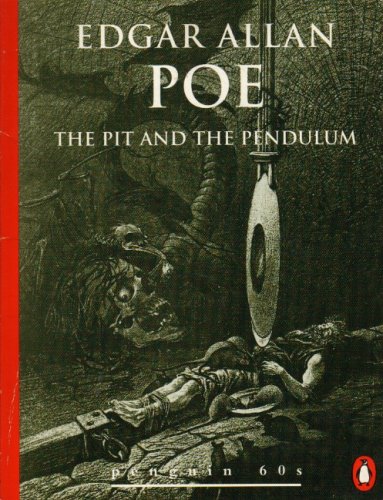
Edgar Allen Poe "The Pit and the Pendulum"

It's quite easy to see how Edgar took influence from Piranesi's series of Prisons for this particular piece of work. The story revolves around a narrator who has been sentenced to death. Upon hearing his sentence he passes out and when he wakes up he's in complete darkness. He gets up and walks a few steps where he stumbles and blacks out again. When he wakes up he finds that although he fell on solid ground his head is over a ledge and he summarises that there must be a pit in the middle of his cell. After falling asleep and waking up again the room is dimly lit and that he is now strapped to a board, when he looks up, he notices that the figure of Time has been painted on the ceiling. Time, however, has been made into a machine, specifically a pendulum, which appears to be swinging back and forth. He looks away from the ceiling, though, when he notices rats coming out of the pit and swarming around his food. When he returns his focus to the ceiling, he discovers that the pendulum is constructed like a scythe and is making a razor-sharp crescent in its descent toward him. The pendulum is moving incredibly slowly with a trajectory right over his heart. When the pendulum nears him he has an idea, he rubs the food onto the straps of his restraints, which attracts the rats over and they chew through, setting him free. When he gets up, the pendulum retracts to the ceiling, and he concludes that people must be watching his every move. The walls of the prison then heat up and begin moving in toward the pit. The narrator realizes that the enclosing walls will force him into the pit, an escape that will also mean his death. When there remains not even an inch foothold for the narrator, the walls suddenly retract and cool down. In his fear, however, the narrator has begun to faint into the pit. To his great surprise, though, a mysterious person latches onto him and prevents his fall.


The following images is a recreation of one of Piranesi's Prison etchings by Joseph Mallord William Turner.  Turner copied this view of an imaginary prison interior from an etching Piranesi. Like other scenes from Piranesi's celebrated Carceri d'invenzione, this image (Dark Prison with a Courtyard for the Punishment of Criminals) presents a cavernous space crisscrossed by labyrinthine walkways and populated by diminutive figures. Turner made this drawing at the beginning of his career, presumably at the evening "Academy" of Dr. Thomas Monro (1759–1833), a pioneering psychologist who welcomed artists to his home to copy or color works in his collection. 

Dark Prison ("Carcere Oscura"), after Piranesi

The original etching done by Piranesi is almost exactly the same as the one by Turner except Turner lightened it up added colour and by doing so I believe took away some of the foreboding and trapped feeling that Piranesi's original etching gives.


Monday, 29 September 2014

Minor project further research

To really do this project properly and create Piranesi's the Prisons series into a 3D world, I need to understand his influences, his reasons for creating them and have a look into the artist that where influenced by him. Hopefully after this I will have a very clear idea on how to create my 3D
environment in a way that is still Piranesi. 

Born in Venice, he got away from the place as soon as he could, but could never leave its pervasive air of decline. He didn't find modernity, or progress, or the Enlightenment. His addiction to the ruins of Rome, his intoxication with their immensity, their power, seems pathological. The chance to see Le Carceri is a chance to look beyond their mythic charisma to find Piranesi himself inside his imaginary spaces.
Hogwarts moving staircases  
As early as 1760 a spectacular set for Rameau's opera Dardanus copied one of Piranesi's boundless prison spaces. It was the beginning of a blackly glittering stage and film career for Piranesi's images, from Metropolis and Blade Runner to the moving staircases at Hogwarts. In today's architecture, you see Piranesi's imagination in Tate Modern, and London Underground's Jubilee line.
Piranesi's chief contribution to practical - as against imaginary - design was to fabricate what an ungenerous critic would call fakes. Piranesi sold "antiques": that is, he put together bits of ancient Roman sculpture that he and others had dug up - a carving of a lion's foot, a couple of fauns' heads - to fabricate imposing, profuse objects you can imagine gracing Nero's palace. 


Eighteenth-century artists, writers and radicals routinely compared the social order to a prison. It seemed as if the boundary between the deathly other world of prison and the illuminated outside world was very thin, as if you could slip constantly between the two, as if the boundaries of prison were able to ensnare you as you slept.
It was only in the second edition of his carceri that Piranesi sited his prisons in ancient Rome. Perhaps he wanted to cover the subversive possibility that these prisons are dream images of his own time, his own society.
Piranesi is more than half in love with his prisons. They are a place his imagination can wander, and at the same time an impossible place - the prints contain spatial paradoxes, including a staircase that exists on two planes simultaneously. It is a place without limits or contexts: Piranesi's prison interiors have no outer walls, and each vista is cut off only by the frame of the image itself. The spaces are so big, so continuous, that they may not even be interiors; this may be a city that has grown into a world, where interior and exterior are no longer definable. There are views through arches of almost recognisable Roman sights - the colonnade of St Peter's. But there is nothing to tell us that these mark terminal points of the prison. Instead, they are incorporated into it.
If inside and outside no longer exist, up and down are what create the sense of power beyond description. While prisoners undergo mysterious torments, luckier souls pass by on parapets or bridges that have no logic or necessity. Piranesi argued that architecture should indulge in grotesque ornament; the architecture of his prisons is redundant, it is not functional, it relishes itself. The awful thing about Piranesi's punishments is that you don't quite know how they work, or what the thinking could be behind them. A wheel with spikes around its circumference; a post with more spikes; a kind of chandelier suspended from a beam, which on closer inspection looks like it might be ringed with meat hooks; pulleys, one of which raises and lowers a basket big enough to contain a person into a huge marble vat.
And yet, in most of the pictures, we don't actually see anyone being tortured. It is all suggested rather than shown. A couple of prison guards - or they might be prisoners doing forced labour - dig a grave in the middle of the prison. Elsewhere, there are glimpses of the damned. A man being pulled on a rack. Naked figures chained to posts while high above them it looks as if a musician is playing the fiddle. Higher still, spectators gather on a vertiginous walkway. It is impossible to tell at times who is a prisoner, who a guard, who a visitor. In the end you suspect that everyone in this place is a prisoner. At the same time, they might all be here by some perverse choice - there is a languid quality to it all; the tortures and chainings are relaxed, almost consensual.
Looking at Le Carceri, it doesn't seem that Piranesi either believed it was possible to escape from the prison he was enclosed in, which was without walls and without an exterior; he was one of the damned. Piranesi seems to think he belongs here, and to have succumbed to the ultimate corruption: taking pleasure in his punishment.

The Prison's series is supposedly based on a malarial fever-dream, the Carceri suggest a descent into the subconscious, an extraordinarily detailed nightmare. This is the Piranesi of the dark imagination that appealed to the fantasies of the Romantics and the psychology preoccupations of the moderns: Thomas De Quincy, in Confessions of an English Opium Eater; Edgar Allen Poe, in The Pit and the Pendulum; Marguerite Yourcenar, in The Dark Brain of Piranesi. The optical-architectural puzzles of M.C. Escher are obvious descendants. In Piranesi’s Dream: A Novel, Gerhard Kopf gives the artist a speech in which he defines architecture as “a sublime symbol for the tension between what you want to do in your own mind and what you are able to do in reality.” Piranesi’s style is full of paradoxes, refracting antiquity through a prism that encompasses Baroque, neoclassical and Romantic.


Minor Project Idea

For my minor project I would like to create an environment based on Giovanni Battista Piranesi's series of 16 etchings "The Prisons" (Carceri).


Piranesi's prisons series takes on from what our perspective could be called "Kaficaesque" *, "Escher" *-like distortion, seemingly erecting fantastic labyrinthine structures, epic in volume, they are "Caprricci" *, whimsical aggregates of monumental architecture and ruin.

* Kafka's writing has inspired the term "Kafkaesque", used to describe concepts and situations reminiscent of his work, particularly Der Process and "Die Verwandlung". Examples include instances in which bureaucracies overpower people, often in a surreal, nightmarish milieu which evokes feelings of senselessness, disorientation, and helplessness. Characters in a Kafkaesque setting often lack a clear course of action to escape a labyrinthine situation. Kafkaesque elements often appear in existential works, but the term has transcended the literary realm to apply to real-life occurrences and situations that are incomprehensibly complex, bizarre, or illogical. Numerous films and television works have been described as Kafkaesque, and the style is particularly prominent in dystopian science fiction. Works in this genre that have been thus described include Terry Gilliam's 1985 film Brazil and the 1998 science fiction film noir, Dark City. Films from other genres which have been similarly described include The Tenant (1976) and Barton Fink (1991). The television series The Prisoner is also frequently described as Kafkaesque.

* M. C. Escher, was a Dutch graphic artist. He is known for his often mathematically inspiredwoodcuts, lithographs, and mezzotints. These feature impossible constructions, explorations of infinity, architecture, and tessellations.


Selection of M. C. Escher's work

* Capriccio means especially an architectural fantasy, placing together buildings, archaeological remains and other architectural elements in fictional and often fantastical combinations, perhaps with staffage of figures. This genre was perfected by Marco Ricci but its best-known proponent was the artist Giovanni Paolo Pannini. This style was extended in the 1740s by Canaletto in his etched vedute ideale, and works by Piranesi and his imitators.

Selection of Marco Ricci's paintings
Selection of (Giovanni Antonio Canal) Canaletto's work
Carcere oscura, Giovanni Battista Piranesi
Piranesi took up architecture as a profession through his father. His mothers brother Matteo Lucchesi is with whom his education was entrusted. Piranesi studied perspective with Carlo Zucchi and as an essential complementary subject, stage-design with the famous Bibiena family. However there was little place for a young Venetian architect so he decided to perfect himself in the art of engraving. One of the plates Carcere oscura from his first series Prima Parte di architetture e prospettive, directly inspired by stage-design, was to appear in 1743 as a prelude to the most celebrated of the artist's suites, the Prisons. 
It is thought that Canaletto, marco Ricci and perhaps Guardi influenced Piranesi and most notably Teipolo.